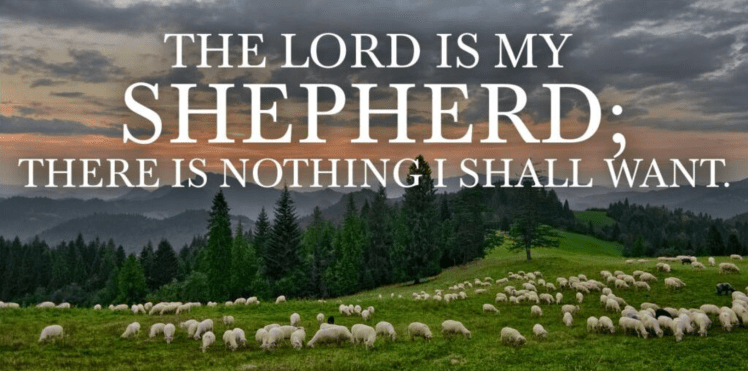
One of the best known, and probably most well-loved images of Jesus is that of the Good Shepherd. It’s a lovely pastoral image of Jesus, usually carrying a lamb in his arms and being followed by a flock of sheep. It’s an image that shows Jesus as someone who looks after and cares for his own, even to the cost of laying down his life for them.
In this morning’s Gospel we hear Jesus telling us something of what the Good Shepherd does, and what it means to be that Good Shepherd. Jesus’ words here are the nearest thing there is to a parable in St John’s Gospel, and they do correspond very closely to the reality of shepherding in his time. Overnight, sheep of a number of different flocks would have been kept in a sheepfold, usually a walled enclosure with an entrance or gate. There would have been a gatekeeper, and they were there to make sure the sheep were kept safe in the sheepfold overnight. They would only have allowed the shepherds to enter the sheepfold, either to bring their sheep in at night or to lead them out to pasture during the day, and the sheep of each flock would have only followed their own shepherd because they’d have recognised his voice. There was of course, always the possibility that someone might try to steal some sheep but, because of the presence of a gatekeeper, those who wanted to do that, would have had to break into the sheepfold by means other than the gate.
In this morning’s Gospel, Jesus doesn’t actually refer to himself as the Good Shepherd, if we read on from the end of this morning’s Gospel, that comes in the very next verse. Instead Jesus says that he’s the gate of the sheepfold, so what does he mean by that? We’ll quite simply it means that it’s only through Jesus that the sheep are kept safe and only through him that they’ll be led to pasture, to the sustenance they need to live. It’s only through Jesus that the sheep will have a full and abundant life. And Jesus contrasts that image of himself as the gate of the sheepfold with one of those whom he calls thieves and brigands or bandits, those who don’t enter by the gate and who only come to steal and kill and destroy. But who are these people?
Just before this, in the Gospel, we read the story of Jesus healing the man born blind. In that story, the Pharisees claim that Jesus can’t be from God because he healed on the Sabbath and therefore, was a sinner. But the man whom Jesus had healed argued with them. He said that if Jesus weren’t from God he wouldn’t be able to perform such miracles. And because of his faith in Jesus, the Pharisees put the man out of the synagogue. So, in the Gospel, this story about the sheepfold is set in the context of an argument about faith in Jesus and about who is the true shepherd of God’s flock.
Through Jesus, the man born blind has entered life, he’s been led to a better life on earth and, through faith in Jesus, to eternal life. He’s become a member of Jesus’ own flock and he now listens to Jesus’ voice.
But the Pharisees look to steal him away from the flock, they urge him to listen to their voice. So, in the context of the Gospel, they, the Pharisees, are the thieves and brigands who are trying to break in to steal and kill and destroy. But we can also read Jesus’ words in a wider context too.
We know that there had been many people whom we might call false Messiahs, people who’d claimed that they were the one who would lead God’s people to freedom, but who, in reality, led the people into armed conflict and death. Perhaps Barabbas was one such person. We’re not told that he claimed to be the Messiah, but we are told that he was in prison for insurrection, for a violent uprising against the authorities. And Jesus warned us that such people would arise in the future too because when he was asked by his disciples about the signs that would herald his return, he said,
“See that no one leads you astray. For many will come in my name, saying, ‘I am the Christ’, and they will lead many astray.”
But we can also read Jesus’ warning as one, not just about false Messiahs, or about those who lead people astray by claiming to speak and act in his name, but about anyone who leads people astray by making false claims, those who say things that lead people away from God and away from his commandments, because he went on to say,
“And many false prophets will arise and lead many astray. And because lawlessness will be increased, the love of many will grow cold.”
And this is perhaps the warning that’s most relevant to us because isn’t this just what we see around us so often in the world today?
If we think about the history of the past hundred years or so, haven’t we seen an increase in ideologies and doctrines that lead people away from God and towards atheism, away from love of neighbour and towards egotism? And haven’t these ideologies and doctrines promised a better life to their adherents but, in fact, caused death and destruction and misery for millions?
Think about Marxism, an inherently atheistic ideology that promised utopia for the working classes. But in reality, how many millions have suffered and died when this ideology has been put into practice? How many suffered and died in Communist revolutions? How many have suffered and died in purges perpetrated by Communist regimes on their own people? How many have suffered and died in what have amounted to proxy wars between the Capitalist West and the Communist East? What is going on in Ukraine at the moment?
Think too about Fascism, another inherently atheistic ideology that, quite literally, promised the world to it’s adherents. How many millions suffered and died on battlefields, in concentration camps, as slave labourers, in towns and cities destroyed in air raids, and on the seas? How many were murdered in cold blood simply because they didn’t agree with the false prophets of this ideology, in the world war that its adherents quite deliberately caused?
But think too about our own inherently self-centred society and ways. Isn’t our own society and our way of life based on the belief that the most important thing in life is our own selves. That what we want is the most important thing in life and that we should be allowed to have what we want regardless of what that means for anybody else. I have the right to do what I want to do, and you have no right to tell me I can’t. I don’t have to do anything I don’t want to do, and you have no right to make me. We call it individual rights. But the only way we can exercise individual rights to that extent is by trampling on the individual rights of others. How, for example, can an individual exercise their right to play music at full volume at 3 o’clock in the morning without denying their neighbour’s individual right to a peaceful night’s sleep?
Perhaps one of the most pernicious ways we see this happening is on social media which is full of people giving advice on how to enjoy a better life. But, if you look at what many of these people are actually saying, they’re telling people to use psychology to make other people do what they want them to do, to use psychological tricks to get what they want from other people. The wishes of the other person or the harm what they suggest doing might do to them doesn’t seem to enter the equation. And almost always, at the end of these things there’s an enjoiner to ‘follow me’ if you like what you’re reading.
We’re surrounded by false Messiahs and false prophets in the world today. We’re surrounded by what, in this morning’s Gospel, Jesus calls thieves and brigands, those who would break in to steal and kill and destroy. In other words, we’re surrounded by people who would lead us astray by leading us away from Christ, away from God’s commandments and away from that love of neighbour that we’re called to have and to show. It can be very tempting to listen to these people because they do promise us good things and a good life. But if we are God’s people, members of Jesus’ own flock, we shouldn’t listen to them. So how do we make sure that we hear the voice of Jesus above the voices of these false Messiahs and false prophets and thieves and brigands?
Well we can do that quite simply by thinking about what the consequences of our actions might be for other people. Before we do something that affects another person, we should ask ourselves whether we would like it if someone else did this to us. And if the answer is no, then we shouldn’t do it to anyone else. I’m sure none of us would willingly harm another human being but, do the views we hold cause harm to other people either by what we say or through the things and people our views and ideas lead us to support? If they do, then perhaps we need to re-think our views.
I hope none of us would stoop so low as to play tricks on people to get what we want from them, but if we are ever tempted to do that, we should first think about how we’d feel if someone did the same thing to us and then perhaps reconsider the course of action we’re planning to take.
People who urge us to be self-centred and to lie and trick and cheat to get what we want can be very persuasive and the rewards they promise for listening to their voices can be very tempting. But Jesus said his flock will hear only his voice and will not listen to other voices. So let’s be sheep of his flock. Other voices may promise us a lot, but Jesus promises us life which is full and abundant. And we don’t have to wait for heaven for that full and abundant life, it can be ours now. It can be ours now because listening to Jesus’ voice changes what we think makes for a full and abundant life. It changes our idea of a full and abundant life from one that’s centred on ourselves and how much we can have for ourselves and to ourselves, to one in which fullness and abundance comes from the quality of our relationships with each other and with God. And if you don’t think that’s possible, just think about the time you’ve spent with people you love, with family and friends. At those times has it mattered one iota what you were doing or how much money you were spending or even where you were? Wasn’t the fullness and abundance of those times found simply in the company of the people you were with and the time you were sharing with them? And this is what Jesus means when he says,
“Truly, I say to you, there is no one who has left house or brothers or sisters or mother or father or children or lands, for my sake and for the gospel, who will not receive a hundredfold now in this time, houses and brothers and sisters and mothers and children and lands, and in the age to come eternal life.”
The voices of the false Messiahs and false prophets of the world, the thieves and brigands who would lead us astray and steal us away from Jesus can be very tempting and very persuasive, but whatever they promise they can’t offer us eternal life and so, in the end, they will kill and destroy us. So let’s not listen to them, but to the voice of Jesus and let’s be and remain sheep of his flock so that we can enjoy life in all its fulness and abundance both now and for all eternity.
Amen.
Propers for the 4th Sunday of Easter, 30th April 2023
Entrance Antiphon
The earth is full of the goodness of the Lord;
by the word of the Lord the heavens were made, alleluia.
The Collect
Risen Christ,
faithful shepherd of your Father’s sheep:
teach us to hear your voice,
and to follow your command,
that all your people may be gathered into one flock,
to the glory of God the Father.
Amen.
The Readings
Missal (St Mark’s)
Acts 2:14, 36-41
Psalm 23
1 Peter 2:20-25
John 10:1-10
RCL (St Gabriel’s)
Acts 2:42-47
Psalm 23
1 Peter 2:19-25
John 10:1-10
 Parish Church of St Mark Chadderton