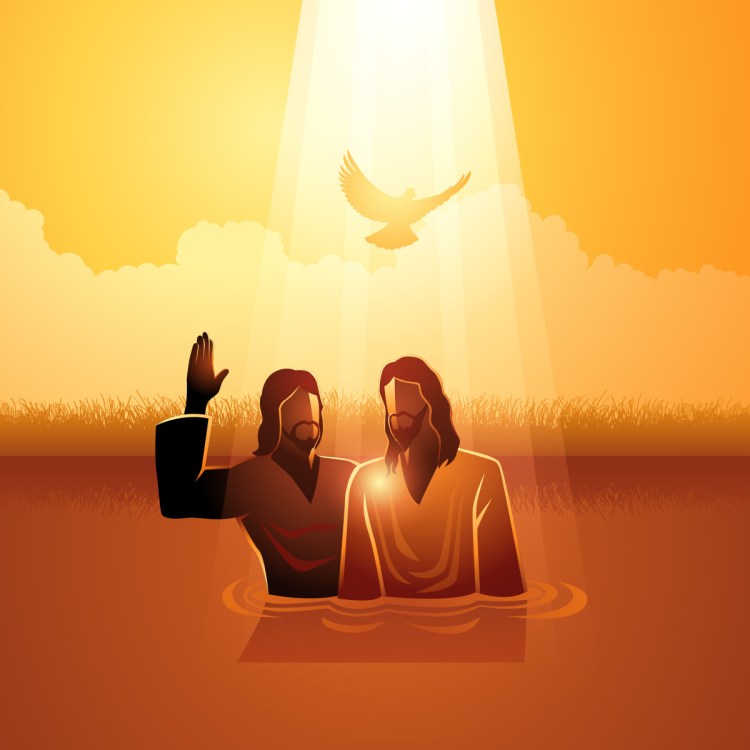
The story of Jesus’ baptism is a very important one. The fact that it’s in the Gospels at all, and all 4 Gospels at that, tells us just how important it is. Because, if we think about it, it would probably have been easier for the evangelists not to mention it at all. They were concerned with showing Jesus to be the Messiah, Immanuel, the Son of God, so it would have been much more convenient for them to have been able to ignore a story which shows Jesus submitting to John’s authority by going to be baptised by him. But the fact that the evangelists did include it in the Gospels tells us two things. One is that Jesus was baptised by John and that this was so well-known that they couldn’t ignore it. And the other is that it must have been too important an event to be left out of the story of Jesus’ life and ministry.
And it is a very important part of the story. It’s important because it marks the public revelation of Jesus as God’s Son, and it marks the beginning of Jesus’ public ministry, or at least the beginning of Jesus’ final preparation for his public ministry because after his baptism there was only his 40 days in the wilderness to go through before he began to proclaim the kingdom and choose his disciples. But having said how important the story of Jesus’ baptism is, we also have to say that it’s a very problematic story, and not just because it shows Jesus submitting to John.
The real problem with the story of Jesus’ baptism is why? Why was Jesus baptised? John himself didn’t understand this and asked what amounts to the same question, as we read this morning:
John would have prevented him, saying, “I need to be baptized by you, and do you come to me?”
And really, Jesus’ answer simply compounds the difficulty in answering this question:
“Let it be so now, for thus it is fitting for us to fulfil all righteousness.”
Righteousness is doing what’s right and good in God’s eyes and so Jesus’ answer tells us that baptism by John was something that was good and right in God’s eyes. But John’s baptism was a baptism for repentance in preparation for the coming of the Messiah, and repentance implies sin. Repentance is about turning over a new leaf. It’s about feeling sorrow for sin, doing something to make amends for sin, and then making a determined effort not to sin again. But Jesus wasn’t a sinner, he was, quite literally, righteousness personified, so why did he need to be baptised in repentance for sin? In what sense did the baptism of the sinless Son of God fulfil all righteousness?
Some people have tried to answer this by using a passage from 2 Corinthians where St Paul says,
For our sake he made him to be sin who knew no sin, so that in him we might become the righteousness of God.
But it was on the Cross that Jesus became sin, where he took on to himself the sins of the world, not at his baptism, so this still doesn’t really answer the question of why Jesus submitted to a baptism of repentance for sin in order to fulfil all righteousness. In fact, no one has ever been able to find a completely satisfactory answer to this question but perhaps as good a way as any to answer it, or at least to approach it, is to view it in the way we tend to look at infant baptism today.
In the Creeds of the Church we say that we believe in baptism for the forgiveness of sin, and in the baptism service itself, we speak about the baptised being cleansed from sin. That makes perfectly good sense if we’re baptising older children or adults but, as we know, the custom of most Churches is to baptise infants, babies; but what sin does a baby need to be cleansed from? What sins has a baby committed?
Traditionally, the answer to this question is that they need to be cleansed from the stain of original sin, that sin which all human beings inherit at their conception as a result of the original sin which Adam committed in Eden. In fact this is why infant baptism has become the norm in most Churches because it was long believed that all human beings share the guilt of Adam’s original sin and that, should they die before being baptised, they would die in sin and couldn’t enter heaven. So, in days gone by when infant mortality was so high, people wanted their children baptised as soon as possible after they were born. And so infant baptism became the norm of the Church; I was less than 2 months old when I was baptised and I’m sure something similar could be said for many of you too. But this understanding of original sin is based on a mistranslation of Scripture.
When it was first translated into Latin, Romans 5:12 was translated so that it referred to Adam ‘in whom all sinned’, implying that all people are sinners simply because they’re of Adam’s race, because they’re human beings. In other words, all people, simply by virtue of their conception as human beings, share the guilt of Adam’s original sin and need to be baptised to be cleansed of this sin, even if they’re too young to have sinned personally. But a more accurate translation of Romans 5:12 reads that sin and death entered the world through Adam, and so to all people, in so much as, or because, all sinned. In other words, people suffer the consequences of Adam’s original sin because it’s through him that sin entered the world, but they don’t share the guilt of Adam’s sin. Human beings are sinners, not because they’re Adam’s descendants, but because they all sin, personally.
This takes away the necessity of infant baptism. That doesn’t mean to say it’s wrong to baptise infants, just that we have to look at infant baptism in a different way. Instead of seeing it as necessary to remove the stain and guilt of original sin, we can look at it as a washing away of an old way of life; the washing away of a way of life in which children are condemned to repeat the mistakes, and sins, of their forebears, so that they can embark on a new way of life; one that’s lived according to the teaching and example of Christ. And this is reflected in the baptism service we use for today. Whilst the service for adults and older children, those old enough to answer for themselves, still speaks about repentance and forgiveness, the service for infants speaks less about these things and much more about dying to sin and rising to new life in Christ.
Baptism is a liminal moment in a person’s life. It’s a moment, a point in a person’s life when they change, when they move from one state of being to another. It’s a time when they leave behind the way of the world and begin a new life following the way of Christ. That’s true of everyone who’s baptised, regardless of their age. The older people are when they’re baptised, the more they have to leave behind because they’ve been following the way of the world, the sinful way of the world, for longer than someone who’s younger. When a baby, someone who’s too young to know the way of the world, is baptised, they have nothing to leave behind so, hopefully and ideally, their whole life will be lived in the way of Christ. We know that doesn’t happen but that’s our fault because who do children learn the sinful ways of the world from if it’s not us? So the intention of baptism is that it is this liminal moment, the point in a person’s life when the old ways are washed away and left behind so that they can move on to a new way, Christ’s way. And this is how we can look at the baptism of Jesus and make sense of it.
John was sent by God to prepare the way for the Messiah. He did that through a baptism of repentance for sin. The intention behind John’s baptism is that, before baptism, people weren’t ready for the coming of the Messiah, after baptism, they were ready for his coming. It was a liminal moment, a point in people’s lives when they moved from being of what we call the Old Covenant to being prepared for the coming of the New Covenant. As God had sent John to do this, it was all part of God’s plan for the salvation of the world. And so being baptised by John was the righteous thing to do, it was what God required of people. Jesus, being sinless, may not have needed a baptism of repentance because he had nothing to repent for, but he was of the Old Covenant, he was born a Jew.
In the Letter to the Hebrews we read the Jesus,
…had to be made like his brothers in every respect, so that he might become a merciful and faithful high priest in the service of God, to make propitiation for the sins of the people.
So what could be more fitting for him to do than fulfil all righteousness under the Old Covenant by doing what God required his brothers to do in preparation for the coming of the New Covenant? What could be more fitting than for Jesus to go through this liminal moment himself, a point in time when he became ready, not for the Messiah, but to be the Messiah? A point in time when he moved from being a private person, living under the Old Covenant, to being a public figure ready to proclaim and usher in a new age under the New Covenant?
If we look at the story of Jesus’ baptism in this way, we can see why, in spite of its difficulties, the evangelists felt it was a story they had to tell. It’s a story that confirms the divine providence of John’s baptism. It’s a story that teaches us something about baptism as a liminal moment in our lives, a point in our lives when we leave behind an old way of life to begin a new way of life. And perhaps above all, it teaches us something about Jesus himself because it’s a story that shows him both in his humanity and his divinity. It’s a story that shows Jesus’ humanity because it shows him to be completely like everyone else, as someone required to do what God required all people to do. And it shows Jesus divinity too as he is revealed to be God’s own beloved Son, openly declared by the voice of his heavenly Father.
Amen.
The Propers for The Baptism of the Lord can be viewed here.
 Parish Church of St Mark Chadderton