I’m sure we’ve all come across the saying, ‘Don’t put off until tomorrow what you can do today’. I’m equally sure that we all know what that saying means – it’s a warning about something that can affect us all, and probably does affect us all at one time or another – complacency. It’s a warning about having a lack of urgency to do something, even when we know that what we have to do needs to be done and should be done.
I’m sure we know this saying, I’m sure we know what it means, and I’m also sure that this kind of complacency is something we’ve all suffered from at times. We’ve no doubt all been faced with a task that’s difficult or unpleasant, or one that we just don’t feel like doing for some reason, perhaps because we have other, easier and more pleasurable things to do, and so we don’t do what we know we should. We think ‘Oh well, I can always do it tomorrow’ and so we put it off. But, as another saying reminds us, ‘Tomorrow never comes’ and so what we’ve put off today until tomorrow, sometimes never gets done at all.
One of the things we hear quite a lot about these days are ‘bucket lists’. I’m sure we all know what a ‘bucket list’ is, it’s a list of things we want to do or achieve during our lifetime before we ‘kick the bucket’. In other words, before we die. I don’t know how many of you have a ‘bucket list’. I know people often talk about things on their list but whether or not they actually have an itemised list of things they want to do before they die or not, I don’t really know. But whether we have a list like that or not, I’m sure we all have in the back of our minds at least, an idea about things we’d really like to do before we ‘kick the bucket’. And yet, how many people, as they come towards the end of their lives, can honestly say that they’ve done everything they wanted to do? How many of us can say that? Probably very few indeed, if any.
Next month, I’m going to fulfil one of the things on my ‘bucket list’ by going to the Passion Play in Oberammergau in Germany. For those who don’t know the story behind the Passion Play, it’s something that dates back to 1634 and an outbreak of bubonic plague in Bavaria. After half of the residents of Oberammergau had died from the plague, the remaining villagers vowed that if God spared them from the plague, they would perform a play, every 10 years, depicting the life and death of Jesus. After they’d made the vow, there were no more deaths and so the villagers fulfilled their vow and have continued to do so ever since.
The reason I mention this is because I first heard about the Oberammergau Passion Play from Fr Neville Ashton and over the years I knew him, it’s something he often said he’d love to see. So when I decided I was going to go to the 2020 play, I asked him if he wanted to come too, and he jumped at the chance. Unfortunately, the 2020 play was cancelled, ironically due to the outbreak of Covid-19, and postponed until this year. Sadly, Fr Neville died in the meantime and so he never did get to see the Passion Play. But, during his adult life alone, he had five opportunities to go to the Oberammergau Passion Play before 2020, and never went. And when he finally did decide to go, circumstances prevented him from going. So if that was an item on his ‘bucket list’ it’s one that he never managed to ‘tick-off’ even though he had a number of opportunities to.
I used that story as an example of how, by putting things off until tomorrow that we could do today, we might never get to do them. The example I used is one from everyday life because it’s an example of someone never getting to experience the pleasure of travelling to see a play because they let so many opportunities to do it pass by. But this is a problem that can affect our faith and our lives as Christians too.
Complacency in our faith and in our lives as Christians comes, I think, in two ways. The first comes with our response to that core teaching of the Reformation, justification by faith, the belief that we are justified, made right with God and saved, on account of our faith alone. There’s no doubt whatsoever that faith is essential to our salvation. Jesus said that the work of God is,
“…that you believe in him whom he has sent.”
And the will of God is that,
“…everyone who looks on the Son and believes in him should have eternal life, and I will raise him up on the last day.”
But with faith in Jesus comes a commitment to live according to his commands and teachings. As he said at the end of that great body of teaching we know as the Sermon on the Mount,
“Everyone then who hears these words of mine and does them will be like a wise man who built his house on the rock.”
And yet how many people do we know whose faith makes little if any difference to their lives? People whose commitment to faith in Jesus goes no further than coming to church from time to time? People who come to Church and yet, in their daily lives, act as though they’ve never heard of Jesus Christ nor know any of the things he taught? People who are, in fact, Christians in name only. And yet so many people like this think that they are right with God simply because they come to Church, or perhaps not even that, but think they’re right with God simply because they say, ‘I believe’? What is this other than complacency, a self-satisfied attitude that leads people to believe that they don’t have to do anything more than they want to do and are doing? But isn’t this the very attitude that Jesus condemns in the parable of the Rich Fool that we read last Sunday?
The second way complacency in our faith shows itself is related to our Gospel reading this morning.
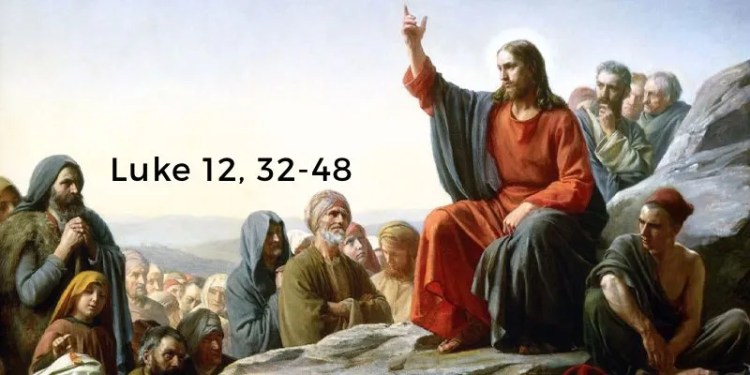
The message of this morning’s Gospel is that we always need to be ready to do God’s will, to do the words that Jesus spoke. That we need to be ready, always, to spring into action to carry out Jesus’ teaching and commands, at a moment’s notice. And we need to be ready because we never know when Jesus will return. This was a teaching, a warning, that the first Christians very much took to heart; they really did believe that Jesus would return very soon, probably within their lifetimes. And so for them, there was no time to be complacent; they couldn’t afford to put off doing what Jesus commanded until tomorrow, they had to do it now. But Jesus said those words almost 2,000 years ago and we’re still waiting for him to return. So for us, that urgency has gone. We’re complacent because such a long time has passed since Jesus said we had to be ready at all times for his return that we always think we have more time. So if we miss an opportunity to put Jesus’ words into action today, it’s not too terrible is it because we can always do it tomorrow. But can we?
Our own experience should tell us that if we miss an opportunity to do something, there’s no guarantee that we’ll ever get another chance. Many of us, perhaps all of us, will have experienced that in some way during our lives. And it’s the same when it comes to putting our faith into practice. If we have an opportunity to do that today, and don’t, there’s no guarantee that we’ll get the chance to do it tomorrow. The particular circumstance may have changed by the time tomorrow comes. The person we could have helped today may have moved on by tomorrow. Perhaps we might not get the chance to do tomorrow what we failed to do today because Jesus does return and finds us unprepared and not busy carrying out his wishes. That may not happen during our lifetime, but one day our time on earth will come to an end and then, just as happened to Fr Neville Ashton who put off going to see the Passion Play in Oberammergau until it was too late, it’ll be too late for us to do tomorrow what we’d put off doing today. And in that case, and in the words of the parable in this morning’s Gospel, how will the master treat us? Will we be lashed, or even cut off with the unfaithful?
This morning’s Gospel makes it clear to us that, when it comes to living out our faith, we can’t afford to put off until tomorrow what we can do today. So what can we do to avoid the fate that Jesus tells us awaits the lazy and complacent who think they can do that? Perhaps one way we can work towards removing complacency from our lives as Christians is to treat every day as though it was our last. To treat every today as though we were sure to meet Jesus before tomorrow comes. Perhaps to see the events of each day as a ‘bucket list’. Not to make a list of what we need to do at the start of the day and then try to work through it during the day, we can’t do that because we never know what the day will bring, what opportunities the day will present us to be about the Lord’s business. But at the end of the day to look back on the events of the day, to think about what opportunities we had to put our faith into practice and then to ask ourselves a question; If I meet the Lord before tomorrow comes, is what I’ve done today enough to give me a place at the table at God’s heavenly banquet?
Amen.
The Propers for the 19th Sunday of Ordinary Time (Trinity 8) can be viewed here.
 Parish Church of St Mark Chadderton