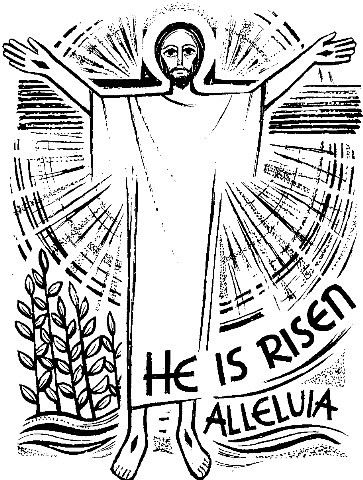
In my sermons on Maundy Thursday and Good Friday, I spoke about those things, the things we remember and celebrate on those days, as being about life. I spoke about them as being about the life we receive and share through our sharing in Holy Communion, about the life of service and self-sacrifice that all Christians are called to live in obedience to Christ, and I spoke about the life we can lead in which our sins can be forgiven, if can only accept ourselves as sinners in need of forgiveness, turn to Christ in faith, and ask for his mercy. I said that if we can only do these things, then the life that Christ offers us through his Passion and Cross is a mortal life that leads to eternal life. And today, on Easter Day, it is that promise that we can have eternal life that we praise and worship God for as we celebrate the Resurrection of our Lord and Saviour, Jesus Christ.
If we look at the Bible as a whole though, we can see it all as being about life. It begins with God’s creation, without which there would be no life at all. But we very quickly move on to what we know as the Fall, the time when the life that God gave us was marred by sin. From then on, the Bible is about God’s calling of people to return to him and the life he created them to live. That’s a story which culminates in the coming of Jesus Christ and his Passion, Cross and Resurrection. The rest of the Bible, is primarily concerned with the way the early Church tried to live out the new life Christ called them to. And if we look at the Bible in that way, we can see this morning’s Gospel reading as the event which brings the story full circle.
In the Book of Genesis, immediately after the sin of Adam and Eve, we find the story of God walking in the garden, looking for his people and calling out to them because they’d hidden themselves from him on account of their sin. Today we heard the story of men and women, again in a garden, but this time they are looking for looking for God, in the person of Jesus, God’s Son. In the story in Genesis, it’s the man and woman who are hidden, but in this morning’s Gospel, it’s God who’s hidden, at least in a sense and for a short time, because Mary mistakes Jesus for the gardener. But even this of case of mistaken identity has its roots in the Genesis story because God appears as a gardener there too: he planted the very first garden, in Eden.
The image of God as a gardener is a very good one. If we go back to the very beginning of the story of creation we told,
In the beginning, God created the heavens and the earth. The earth was without form and void, and darkness was over the face of the deep. And the Spirit of God was hovering over the face of the waters.
So what we read here is not only that God creates, but that he also brings order to chaos. And isn’t that just what a gardener does?
If we think about what a piece of land is like when it’s untended, we could say it’s chaotic; it’s simply an unordered tangle of wild growth. We’ve both had and have areas like that around our churches, so we know what a piece of land looks like when it’s left to grow wild. But if we put a gardener onto that piece of land, it becomes very different; the wild growth is cut back, harmful plants, weeds and so on, are removed and replaced with good, beautiful plants, flowers, shrubs and lawns. In time, a gardener can turn what was once an overgrown mess into something beautiful so, in effect, a gardener, just like God, creates order from chaos.
This idea of God creating order from chaos is one that was very deeply ingrained in the Jews of Jesus’ day. In fact, their whole view of the world and the universe was based on it. Even the Jerusalem temple was built to mirror this idea of God creating order from chaos. It’s a view of the world and the universe that’s sometimes likened to the rings of an onion. For the Jews, God was at the centre of all and then here were various stages of closeness to God and furthest from God, where God’s presence wasn’t known or wasn’t at work, there was chaos. And chaos was closely associated with death.
In the Old Testament, the dwelling place of the dead was known as Sheol. Sheol was described as a place very reminiscent of the world we read about at the beginning of Genesis, a place of darkness and deep waters. We also find in the Old Testament the idea that those who dwell in Sheol, the dead, are cut off from God. So if Sheol, the dwelling place of the dead can be equated with chaos, then chaos can be associated with death, and in that understanding, the life and ministry of Jesus, his teaching and example, and especially his Passion, Cross and Resurrection, which are all about life, must also be about bringing order to chaos.
In the Creeds of the Church we profess our belief that, after his death on the Cross, Jesus descended to the dead, he went into Sheol, that place of chaos, to bring order and life even there by proclaiming the Gospel to the dead.
And if we think about it, isn’t that exactly what Jesus brings to us too; order to the chaos of our earthly, human lives?
If we think about human life as it’s lived without any belief in God, or obedience to Christ, what is it but a chaotic mess? What is it but a chaos of self-centred, competing individuals and nations who all want their own way? To use the gardening analogy, what is life without belief in God and obedience to Christ but a chaos of self-centred individuals and nations who all want the garden to be ordered according to their own idea of how it should be ordered? A chaos of self-centred individuals and nations who aren’t even content with ordering their own garden in the way they want, but who are quite willing and happy to tear up anything that any other gardener plants so that they can order everyone else’s garden in the way they want it to be ordered? And ultimately, where does all this chaos lead any of us except to the grave? Where does all of the chaos of human life lived without belief in God and obedience to Christ lead any of us except to death?
But with belief in God and obedience to Christ, the chaos is replaced with order and death is replaced with life. Through his life and ministry, through his teaching and example, and through his Passion and Cross, Jesus offers us life. He offers us a life in which we can once again walk with God in his own garden, a world ordered according to his plan. And he offers us that life not only for the brief time of our earthly lives, but he offers us the chance to live that life for eternity. He offers us the chance to live our lives on earth according to God’s plan so that, when our time on earth is done, we can escape the death and chaos of Sheol, and live and walk with him forever in God’s heavenly garden.
For many people, that perhaps seems too good an offer to be true and so it’s an offer they can’t, and don’t, take seriously. But today, Easter Day, the day when we celebrate the Resurrection of Jesus Christ, not only our Lord and Saviour, but our brother and fellow traveller through the chaos of human life, is the proof that his offer is a true one. So let’s take him up and that offer and walk with him in this life so that we can live and walk with him forever in paradise.
Amen.
The Propers for Easter Sunday can be viewed here.
 Parish Church of St Mark Chadderton