Not too long ago, reports emerged that the present Archbishop of Canterbury had expressed his doubts about the existence of God, and indeed, I spoke about this in a sermon when these reports emerged. But as disappointing as that may be coming from an archbishop, it’s probably not something that would have come as too much of a surprise to anyone who’s been a member of the Church for any length of time. Some of us I’m sure, for example, will remember the explosion of controversy, not to mention anger of many in the Church when, in the mid-1980s, the bishop elect of Durham, David Jenkins, said that he doubted the literal truth of the virgin birth and the physical reality of Jesus’ Resurrection. On that occasion a petition was raised and signed by over 10,000 people asking the Archbishop of York not to consecrate David Jenkins as bishop. The petition fell on deaf ears but when, 3 days after his consecration as bishop, York Minster was struck by lightning and was severely damaged by the ensuing fire, some saw this as a sign of divine wrath at Bishop Jenkins’ appointment.
It’s sad, but true that, for quite some time now, some people in the Church have been only too eager to express their own doubts about their faith and about the truth of the Scriptures in public. And, as we live in an increasingly secular society, and those in the public eye, such as bishops and archbishops, don’t seem to see anything wrong with expressing their doubts to the media, is it any wonder that these things are given the publicity that they are and that the Church is held in such low esteem these days? After all, why would anyone listen to a Church whose leaders say, quite publicly, that they doubt the truth of what the Church proclaims and teaches?
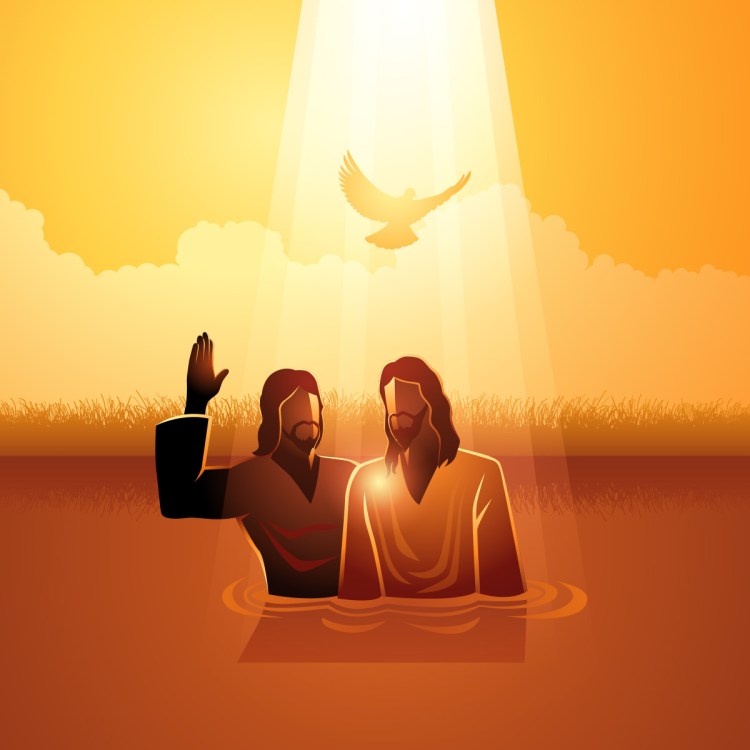
But whatever people believe about what the Church teaches and what the Scriptures say, one bible story which is never called into question is the one we heard in our Gospel reading this morning; the story of Jesus’ baptism by John the Baptist. One of the reasons for this is that we find it in all the Gospels. Matthew, Mark and Luke tell the story explicitly and whilst John doesn’t do that, he certainly alludes to it because in John’s Gospel, John the Baptist says of Jesus,
“I saw the Spirit descend from heaven like a dove, and it remained on him. I myself did not know him, but he who sent me to baptize with water said to me, ‘He on whom you see the Spirit descend and remain, this is he who baptizes with the Holy Spirit.’”
Another very good reason for our belief in the truth of this story is that it’s told at all, let alone by all the evangelists. The Gospels are very keen to point out that Jesus is superior to John the Baptist, indeed they record John having said this himself. So why would they tell a story about Jesus being baptised by John, submitting to John in a sense, unless it was not only true but also widely known to have happened and therefore, impossible to ignore?
But if we can’t doubt the truth of Jesus’ baptism by John, that still leaves the question of why Jesus went to John to be baptised? Why should the Son of God go to a man, even one as great as John, and submit to him in this way? Or, to put the question in John’s terminology, why should the greater submit to the lesser? Only Matthew, in his Gospel, gives us an answer to that. St Matthew tells us that,
‘Jesus came from Galilee to the Jordan to John, to be baptized by him. John would have prevented him, saying, “I need to be baptized by you, and do you come to me?” But Jesus answered him, “Let it be so now, for thus it is fitting for us to fulfil all righteousness.”’
For the Jews, and we must never forget that Jesus was a Jew, righteousness was about living in a right relationship with God. It’s what God called all his people to be through his covenant with them. So to fulfil all righteousness was to do everything that God required under the terms of the covenant between himself and the people of Israel. God had sent John to proclaim the coming of the Messiah, and to baptise the people in readiness for his coming. So being baptised by John was also something that God required of his people and as Jesus was one of God’s people, it was something God required of him too. And if we look at it in this way, we can see that Jesus baptism by John is a display of his humanity; that he was, as the author of the Letter to the Hebrews puts it ‘completely like his brothers and sisters’.
Jesus though, as well as being human, was and is, also divine. Jesus is the Son of God and so through him, God tells us what we need to do to fulfil all righteousness. We find out what this means through Jesus’ teaching and example, but we’re also told what it means in the Great Commission that Jesus gave to us, his disciples. St Matthew tells us that,
Jesus came and said to them, “All authority in heaven and on earth has been given to me. Go therefore and make disciples of all nations, baptizing them in the name of the Father and of the Son and of the Holy Spirit, teaching them to observe all that I have commanded you.”
The words of the Great Commission make it quite clear that, just as it was for Jesus, baptism is something that God requires of us today too. One of the problems we have with baptism in the Church today though, is that people don’t bring their children to the Church to be baptised in anywhere near the numbers they once did. Quite often too, baptisms take place outside the Mass, the Eucharist. Strictly speaking, that should only happen in the case of emergency baptism but these days, it happens more often than not. There are reasons for this, not least that people who bring their children to Church to be baptised are very often only interested in having a nice day – half an hour in Church, a few nice photos and then a party. The spiritual significance of baptism is hardly given a thought, if it’s given any thought at all. Because of that, people can be very disruptive if they’re asked to be in Church for the whole of a Sunday service because they’re simply not interested in anything other than the baptism. I’ve been present when that’s happened. I can remember more than one occasion when a baptism party has been so disruptive after the baptism that they’ve been asked to leave the Church either by the vicar or the churchwardens. On one occasion when that happened, the baptism party did leave and then started what turned out to be a mass brawl in the churchyard!
One unfortunate consequence of this though, is that most people who do come to church regularly, hardly ever take part in a baptism. And the regular members of a church are expected to take part in a baptism. They’re expected to take part through their own responses to the questions put to the congregation and they’re expected to take part by promising to uphold the newly baptised in their life in Christ, and to welcome them as new members of the Church. But as well as not being able to do that, not being present at baptisms denies people the opportunity to be reminded of their own commitment to fulfil all righteousness made in their own baptismal promises and the vows they made at their own confirmation.
I’m not asking anyone to answer these questions now, but I am asking you to think about them and answer them for yourselves. How long is it since you thought about your own baptismal promises and confirmation vows and what they mean? How long is it since you really thought about those baptismal promises to reject the devil and all rebellion against God, to renounce the deceit and corruption of evil and to repent of your sins? How long is it since you really thought about what it means to turn to Christ as your Saviour, to submit to him as your Lord and to come to Christ as the way, the truth and the life and to make his way, his truth and his life your own?
If you’re confirmed, how long is it since you thought about the vows you made at your confirmation, the vows to continue in the apostle’s teaching and fellowship, in the breaking of bread and in prayer, in other words, in your vow to come to Church regularly? How long is it since you thought about your vow to resist evil and, when you do sin, to repent and return to the Lord? How long since you thought about you vow to proclaim the Gospel by both word and deed? How long since you thought about your vows to love your neighbour as yourself, to acknowledge Christ’s authority over us, to pray for the world, to help the weak, and to seek peace and justice? How long is it since you recalled that, at both your baptism and confirmation, you were anointed to symbolise your reception of the Holy Spirit of God to guide and strengthen you in your attempt to fulfil all these promises, to fulfil all righteousness, as God requires us to do? How long since you remembered that you received a lighted candle to symbolise not only that you are called to walk in the light of Christ all the days of your life, but also to be a light in the world yourself, to the glory of God the Father?
I’m sure you all try to do these things, as we all do. But the promises and vows we made to do them are hard to keep and none of us ever keep them all as well as we could and should. So it’s never a bad thing to be reminded of them from time to time, just to keep us on our toes. It would be nice if we could be reminded of them by a regular stream of baptisms in church on a Sunday morning, during the Mass, the Eucharist, but unfortunately, that doesn’t happen these days, so we have to be reminded in other ways, or to find other ways to remind ourselves of the promises and vows we made to fulfil all righteousness.
I don’t think people should criticise themselves unnecessarily because there are plenty of people in the world who’ll do that for them without any help or encouragement. Unfortunately though, we have lots of people in the Church who, by being critical of their own faith, have given more than enough help and encouragement to those outside the Church to criticise both the Church and our faith. But if we can take some time to think about our baptismal promises and confirmation vows and try to keep them a little better than we might have done in the past or are doing now, if we can do all we can to fulfil all righteousness in our lives, at least we shouldn’t be giving any help or encouragement to those who are looking to criticise us, the Church, or our faith.
Amen.
The Propers for The Baptism of the Lord can be viewed here.
 Parish Church of St Mark Chadderton