Those of you who’ve been in higher education will know that for each course, or unit of a course that you do, you’re given a bibliography, a list of books that you’re either expected to read or that it’s at least suggested you read to help you with studying that particular course or unit. That was certainly something that happened when I was an ordinand at Mirfield.
Typically, a course or unit bibliography at Mirfield would be about 2, A4 pages long. But one of our lecturer’s, Fr Thomas, a member of the religious community at Mirfield, was a little more demanding. He’d give his students a bibliography up to 2 pages long for every lecture. Not only that, but he’d also turn up for every lecture with a stack of books under his arm that he either especially recommended or that he either hadn’t had time or space on the paper, to add to the bibliography. And if that wasn’t asking enough of his students, quite a few of the books he recommended weren’t even written in English. So, as Fr Thomas went through the books, as he did at the end of every lecture, there would always come a point where we’d hear something like this, which is actually taken from one of the bibliographies he gave us:
‘For those who have German, I recommend Medard Kehl’s Die Kirche, if any of you have French, I recommend De Lubac’s Corps Mystique.’
But it could be that, for those who ‘had’ the languages, Fr Thomas might recommend books in any one of the seven languages he was fluent in.
But it got even better, or perhaps worse than that. If he was quoting from one of these foreign language books and he thought that something might be lost in translation, Fr Thomas would just quote in the original language. I’m sure you can imagine the bemusement, and amusement too it must be said, that caused among the students. And we were bemused at times because, if you didn’t ‘have’ the language, it wasn’t a case of something being lost in translation, but of everything being lost in the lack of translation, because you didn’t understand a word he was saying.
That story is really just an example of something that I’m sure we all know, and that’s just how difficult it is for people to understand one another if they don’t speak the same language. And if we think about how difficult it is for people to communicate when they don’t speak the same language, we can perhaps get a clearer sense of the difficulty and enormity of the commission Jesus gave to his disciples before his Ascension.
As we know, Jesus told his disciples to go out into the world, to teach the people of the world all the things he’d taught them, and to make disciples of the people of all nations. But I wonder if we can imagine just how bemused the disciples must have been at Jesus words. Not because they didn’t understand his words, but because they understood the words exactly, they understood just what his words meant and wondered just how they were going to carry them out. We have to remember that Jesus’ disciples were Galileans, and for the most part, Galilean fishermen. Perhaps some, like Matthew who’d been a tax collector, might have spoken some Greek, the international language of the day, but for the most part they would have spoken Aramaic and Hebrew. How were they going to tell and teach people of other nations and languages about Jesus?
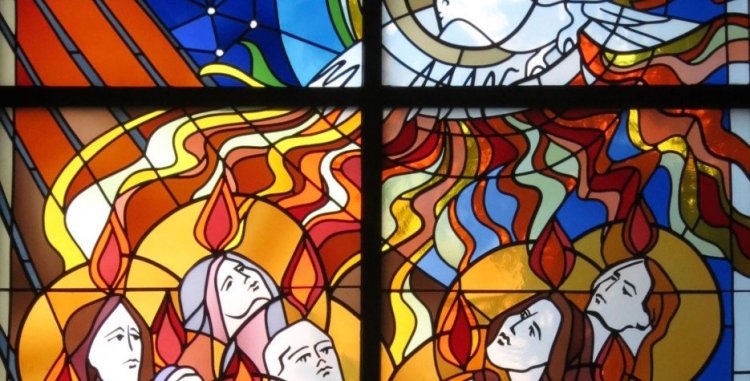
When we think about the commission Jesus gave his disciples in those terms, it really should come as no surprise that the first gift the Holy Spirit gave the disciples on the day of Pentecost, was the gift of speaking “other tongues”. We read about speaking in tongues in various places in Scripture and what often seems to be meant by tongues, is a strange, perhaps heavenly language that no one on earth usually speaks, the meaning of which needs to be interpreted by someone who has the gift of interpreting tongues. But the particular gift of the Spirit on the day of Pentecost was the gift of speaking other languages, and it was given to the disciples so that they could fulfil the great commission Jesus had given them. It was given so that the disciples would have the ability to pass on their knowledge and understanding of Jesus to people of different nations, races and languages, and make disciples of them.
That tells us something very important about the gifts of the Spirit. When we think about the difficulty and enormity of the task Jesus had given the disciples, and who and what those disciples were, the most astounding thing about it is, that they actually did carry out the task Jesus had given them.
In the face of state sponsored opposition and persecution, within less than 300 years, a Church which The Acts the Apostles tells us numbered a total 120 believers at the time of Pentecost, grew into the official state religion of the Roman Empire. An empire of about 55 million people that covered most of Western Europe, the Near and Middle East and North Africa.
Now, of course, we can manipulate numbers in all sorts of ways, and not all of those 55 million people would have become Christians simply because the emperor said they should. After all, one of the reasons the Church was persecuted was because it wouldn’t obey the religious dictates of the Roman emperors. But, in terms of growth, a rough comparison with our own situation would be the people of this united benefice, which has a combined electoral roll of 82 members, converting the population of Oldham and Rochdale to Christianity in 5 or 6 years. If we were told to do that, I think we’d be quite bemused and wonder how we were going to do it. But that’s the scale of growth the early Church achieved. If we were asked to do that, we might think it was impossible, at the very least we’d be daunted by the enormity of the task. But what the gift of the Spirit at Pentecost tells us, is that God doesn’t look at our abilities and give us tasks that suit our abilities. God looks at the tasks that need to be done and sends his Holy Spirit to give us the gifts and abilities to do them. How else can we explain the growth of the early Church?
Today, the Church faces many problems, not the least of which is the decline in the number of people who come to church and who consider themselves to be Christians, even in a nominal sense. Stopping that decline and reversing it so that the Church begins to grow is probably the biggest task that we face in the Church at this time in our nation and society. And I think, in many ways, one of the biggest problems we have in teaching people about Jesus and making disciples in our nation today, is a problem of language. It’s not that people don’t understand English, it’s that they don’t understand the language of faith and religion. To many people in our country today, the language of faith and religion is completely alien to them and so, if we try to speak to them about those things, we might as well be speaking a foreign language.
I’ll give you an example of what I mean. A few years ago, before I was ordained, I was driving to a site near Scunthorpe to work. I had a young lad, in his late teens in the car with me, and he noticed the palm cross I had behind the rear-view mirror of my car. He asked me what it was but as I explained, I could tell that he really didn’t understand a word I was saying. We established that he had heard of Jesus Christ and that he thought Jesus had ‘something to do with Christmas’, but that was about as far as his knowledge and understanding went. He never once said he didn’t believe anything I said to him, and we spoke for quite a long time, for most of the journey as I recall, but it was obvious that he had no understanding of who Jesus was or is. No understanding of worship or prayer or of why people go to church. No understanding of sin and forgiveness. No understanding of the Cross or of sacrifice. No understanding of religious symbolism; he seemed to think the palm cross in my car was ‘a good-luck charm’. Now I’m sure that young lad understood my words, we couldn’t have had a conversation at all if he hadn’t understood my words, but he didn’t understand the meaning of what I was saying because all the things I was talking about, the things that are central to our faith and religion, were completely alien to him. And in that sense, I was speaking to him in a foreign language, one that he didn’t understand.
So how do we speak to people who don’t understand the language of faith and religion in ways that they will understand. Well, if people don’t understand our words, we obviously need to speak to them in non-verbal ways, and that means we have to speak to them through our actions.
It’s believed that one of the things that helped the early Church’s phenomenal growth was that, in a world that was very inequitable, a world where slavery was the norm, the Church’s Gospel of salvation for all, it’s proclamation that all people, from the lowest slave to the highest ruler, were of equal importance and worth, it’s practice of holding all things in common and of caring for the sick, the poor and needy, spoke to people in a very, very powerful way. We know that our world is still inequitable today. There’s still great injustice in the world, there’s still exploitation of the weak by the strong in the world and there’s still sickness, need and poverty in the world. People may not understand our words, but if our deeds show that we care about these things, and care about them enough to do what we can to alleviate them, people will understand that. Perhaps then, they might be a little more inclined to take the time to learn the language of faith and religion that we speak, so that when we do speak to them about Jesus and his teachings, they will understand what we’re saying, and we can make disciples of them.
Amen.
The Propers for Pentecost can be viewed here.
 Parish Church of St Mark Chadderton