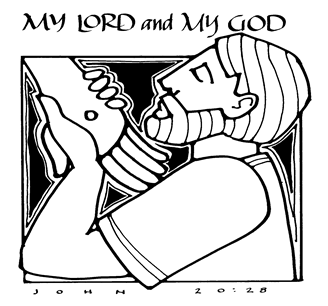
In this morning’s Gospel, we heard the well-known story of the disciple, Thomas. I don’t know about you, but I feel a little sorry for Thomas because I think he gets unfairly singled out for a bad rap. We call him ‘Doubting Thomas’, don’t we? Doubting Thomas, the one who didn’t believe that Jesus had risen from the dead and wouldn’t believe it unless he could see and touch Jesus for himself. But really, were any of the other disciples any better than Thomas? Were any of them any more believing than Thomas? If we read the Scriptures, the answer has to be not only a resounding ‘No’, but that some of them were even harder to convince of Jesus’ resurrection than Thomas was.
When we read the Gospel accounts of Jesus’ Resurrection, we find that none of the disciples believed it at first. Despite the fact that Jesus had told them that he would rise again after 3 days, their first thoughts on finding the empty tomb were that Jesus’ body had been removed and taken away. We’re told Peter and the beloved disciple saw the empty tomb but didn’t understand that Jesus must rise from the dead. Mary saw Jesus but didn’t recognise him. She didn’t believe until Jesus called her, by name. But, when the other disciples were told that Jesus had risen, they didn’t believe it, they thought it was ‘an idle tale’, in other words, they thought it was utter nonsense. Later, when Jesus appeared to them, they thought they were seeing a ghost. And even when some did believe and worshipped Jesus, we’re told that some still doubted.
So ‘Doubting Thomas’ was by no means the only disciple to have doubts, and he was by no means the hardest to convince that Jesus had indeed risen from the dead. All the disciples had their doubts. None of them believed, until the evidence of their own senses, their eyes and ears had convinced them that Jesus was risen. And some doubted even after they’d seen Jesus and heard him speak to them.
As unseasonal as it might be, the disciple’s reaction to Jesus’ Resurrection reminds me very much of the way Ebenezer Scrooge reacts to Marley’s ghost in Charles Dickens’ A Christmas Carol.
If you’ve read the book, or seen a film version of it, you’ll remember that Scrooge first sees Marley’s ghost in the door knocker of his house, and he thinks it’s “Humbug!” a hoax, some kind of fraudulent nonsense. These days we might call it a ‘wind-up’. Nevertheless, when Scrooge gets into his rooms, he locks himself in.
But Marley’s ghost appears to Scrooge in his locked room. But Scrooge still won’t believe it. Marley’s ghost asks him what more evidence does he need beyond that of his own senses and why does he doubt his senses, to which Scrooge replies that even a little thing, something as simple as a slight stomach disorder can affect them and make them cheat and cause him to be persecuted by a legion of goblins. And if we think about those things, the disbelief, the appearance of what seems to be a ghost in a locked room and the refusal to believe the evidence of the senses, aren’t these things very reminiscent of the disciple’s reaction to the news of Jesus’ Resurrection and to him appearing to them?
As we read on through the Scriptures, we find that it was only with the coming of the Holy Spirit at Pentecost that all the disciple’s doubts and fears were finally taken away. And that tells us something very important. It tells us that, however we come to believe, whether it’s by the words of another, or through the evidence of our senses, such as witnessing or receiving Christian charity, or through a personal revelation, ultimately, faith is a gift of the Holy Spirit; it’s a gift from God.
We know that faith is required for salvation, Jesus himself tells us that when he says,
“Whoever believes in me, even though he die, yet shall he live, and everyone who lives and believes in me shall never die.”
We also know that the gift of faith is available to all people. We couldn’t really talk about a God who is love if that weren’t the case because it would mean that God only loves some, or at least some more than others. And indeed, in his sermon on the Day of Pentecost, St Peter said as much when he quoted the prophet Joel, who said,
“‘And in the last days it shall be, God declares,
that I will pour out my Spirit on all flesh” … And it shall come to pass that everyone who calls upon the name of the Lord shall be saved.’
And Jesus brings these things together when he says,
“God did not send his Son into the world to condemn the world, but in order that the world might be saved through him. Whoever believes in him is not condemned, but whoever does not believe is condemned already, because he has not believed in the name of the only Son of God.”
So, it’s clear that God wants all people to be saved. But, if God wants all people, the world, to be saved through faith in Jesus, and has poured out his Holy Spirit on all people to give them the gift of faith, why is it that some people have faith and others don’t?
There can be a number of reasons for that. The cruelty and injustice of the of the world is one reason people often give for having no faith. The unscientific nature of faith, the fact that things like the existence of God can’t be scientifically proven or that the Resurrection can’t be explained in a scientific way, is another reason people often give for having no faith. But ultimately, perhaps the real reason some people have faith and others don’t is that some people are more open to the Holy Spirit than others. Some people, is spite of any doubts and fears, will allow that spark of faith that the Spirit brings, to burst into flame whereas others, through their own doubts and fears, will snuff the flame of faith out before it ever becomes more than a spark.
Again, this is something we find in Dickens’ A Christmas Carol. The first spirit who visits Scrooge, the Spirit of Christmas Past, has a bright light shining from it’s head. But what the spirit shows Scrooge it too painful for him to see, he can’t bear to have his past faults and failings, his sins, exposed to the light, and so he forces a candle extinguisher on to the head of the spirit to put the light out. He can’t, the light still shines out from under the extinguisher, but it doesn’t shine on him anymore. And there’s more than a hint of similarity between this scene from Dickens’ novel and Jesus’ words:
“And this is the judgement: the light has come into the world, and people loved the darkness rather than the light because their works were evil. For everyone who does wicked things hates the light and does not come to the light, lest his works should be exposed. But whoever does what is true comes to the light, so that it may be clearly seen that his works have been carried out in God.”
In the end, Scrooge does accept what the spirits are trying to tell him, and he repents. He pledges to take their message to heart and change his ways, but only because he’s terrified by the thought of his own death. And how many people have we met who are like that? People who say they have no faith and who have little if any time for the Christian faith or the Church; people who are often quite hostile to the Christian faith and the Church, but who yet, when they’re faced with the prospect of death, either their own or that of someone they know and love, suddenly want faith and want faith to be real?
We see that so often when people who want nothing to do with the Christian faith or the Church normally, suddenly when they’re faced with some crisis, and especially when they’re faced with the prospect of death, want the Church and individual Christians to pray for them. Of course, we will and do pray for them because it’s what we should do as Christians; it’s part of loving them as Christians should. But I don’t think there can be any doubt that God’s Holy Spirit has offered them the gift of faith, but they’ve refused to accept it and believe and instead have snuffed out that spark of faith that the Spirit’s tried to fan into flame in them?
In this morning’s Gospel, Thomas makes a great confession of faith in Jesus as his “Lord and God.” And Jesus replies by saying,
“Have you believed because you have seen me? Blessed are those who have not seen and yet have believed.”
We can count ourselves amongst those whom Jesus says are blessed in this way. In fact, we’re doubly blessed because earlier in the Gospels, when Simon Peter declares Jesus to be “Christ” and “the Son of the living God”, Jesus says to him,
“Blessed are you, Simon son of Jonah! For flesh and blood has not revealed this to you, but my Father who is in heaven.”
And we’re blessed in this way also because we believe this about Jesus too.
The Holy Spirit has been, and is, poured out on all people and so these same blessings are available to all people because faith is available to all people. We know that not all people accept the gift of faith, but we have accepted it. So let’s pray for those who haven’t, that they will allow the Spirit to fan the spark of faith within them into flame. And let’s give thanks to God that we have been and are so blessed. Blessed to recognise Jesus as Christ and Son of God. Blessed to be able to recognise Jesus as our Lord and God, without having seen him. And blessed with the gift of faith through which Jesus has promised us the greatest blessing of all, the blessing of eternal life.
Amen.
The Propers for the Second Sunday of Easter can be viewed here.
 Parish Church of St Mark Chadderton