Last week’s Gospel revolved around two questions that Jesus put to his disciples: who did the people think he was, and who did they think he was? In my sermon I said that Peter answered that question for Jesus’ disciples both then and now when he said that Jesus was the Messiah, the Son of the living God. But, when we see the behaviour of some people in the Church, I think we have to question whether or not they really believe that. To be honest, I think we have to question whether some people in the Church are really Christians at all, or whether they’re simply people who go to church for some other reason.
If people really do believe that Jesus is the Messiah and Son of the living God, they’d also believe that Jesus is the Way, the Truth, and the Life, and if they believed that, they’d do their best to do in their lives what he did in his. But, in many cases, we know that they don’t. I’m not talking here about the sins we all commit from time to time, the sins of negligence and weakness that we commit because of our human frailties, I’m talking here about the deliberate sins that people commit, often repeatedly, in full knowledge that what they’re doing is contrary to the teachings and example of Christ, and in full knowledge that what they’re doing has no place in the lives of his disciples.
We know only too well, for example, because some of these cases have been well-publicised, that some members of the clergy have acted in the most appalling way towards children and young people. But there are also other cases of appalling behaviour by people in the Church that are very rarely publicised and that are usually known only to those directly involved in them or affected by them, but which are far, far more common and widespread than the cases we hear about in the media. Things like people who’ve become far too big for their boots, throwing their weight around in the Church. People bullying others in the Church and trying to get rid of them from the Church because they don’t like them or disagree with them in some way. People causing trouble in the Church because they want their own way and think everyone else in the Church should back down and let them have it, regardless of whether their own way is right or wrong.
These things are usually associated with what’s often referred to as the clique in a church, and that is a very common and widespread problem. But they’re what I call a symptom of the problem that arises in a church when people, some people at least, start to treat the Church as nothing more than a private social club for them, their families, and their friends. A private social club in which they make the rules and in which they think, they should decide who can have a say in running things and who can’t, and even who can be a member and who can’t. I think that really is the problem because it’s these club members who make up the clique in a church.
We might not think that this kind of thing is as bad as the more well-publicised examples of Church people behaving badly, but these things are still wrong: they’re still things that Christians shouldn’t do, to anybody, let alone to other members of the Church. In terms of Christian behaviour, in terms of discipleship, they’re just as bad as many more well-publicised cases because, just like those well-publicised cases, they bring the Church, and the Christian faith into disrepute. They drive people out of the Church; they drive people away from the Church and deter them from wanting to come to church and from being part of the Church. And in doing that, ultimately, they drive people away from Christ and stop them from coming to Christ. So all examples of un-Christian behaviour by people in the Church, whatever they are, are stumbling blocks to Christ, and they all result from minds that are set on human things rather than on divine things. From minds that are set on their own way rather than God’s way, the way the Truth and the Life set out, and lived out, by Jesus.
So I do think we have to ask whether people who do this kind of thing really are Christians, or whether they’re just people who go to church for some kind of earthly reward that it gives them. But, as Jesus makes perfectly clear in this morning’s Gospel, that is not what Christians are supposed to do and so it’s not what we should be coming to church for. And we can’t possibly square that kind of attitude and behaviour with what we heard this morning:
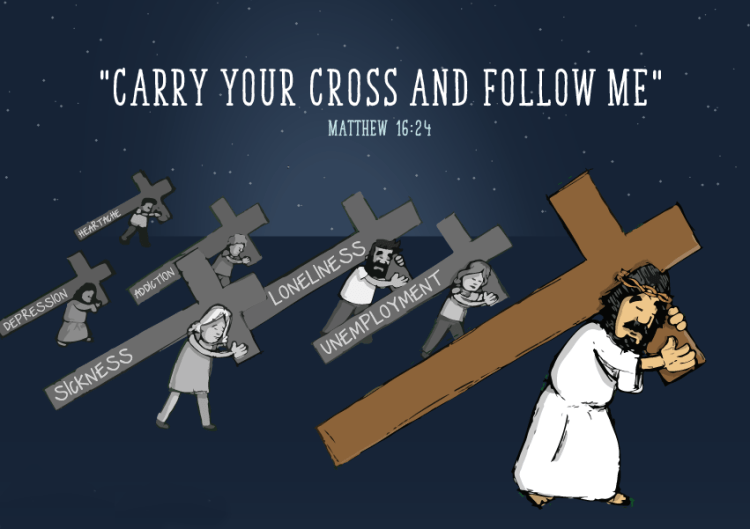
“If anyone would come after me, let him deny himself and take up his cross and follow me. For whoever would save his life will lose it, but whoever loses his life for my sake will find it. For what will it profit a man if he gains the whole world and forfeits his soul? Or what shall a man give in return for his soul?”
What we should be coming to church for is to look for that life that Jesus is talking about, the eternal life that he promised to all those who believe in him. And if we believe in him, if we really do, truly believe in him, that’s what we’ll do. We’ll give up looking for earthly rewards and put our efforts into looking for a heavenly reward. And we’ll come to church to learn how to do that from Jesus himself, and then we’ll follow him and his way. The alternative is that we look for whatever earthly reward we can get from the Church now. And, believe me, that’s never going to amount to very much. Jesus said that the whole world isn’t worth losing our soul for and that there’s nothing we can give in exchange for our souls, in other words, our immortal soul is the most precious thing we possess or can possess. So why do people jeopardise their soul for so little?
In a historically inaccurate, but very powerful scene in the film A Man for All Seasons, Sir Thomas More, having just been betrayed to death by the perjured testimony of his one-time friend, and now Attorney General for Wales, Sir Richard Rich, More says to Rich,
“Why Richard, it profits a man nothing to give his soul for the whole world. But for Wales?”
But it seems that some people in the Church are willing to jeopardise their souls for even less than that: not for the whole world, not even for Wales, but for what? For a few moments of physical pleasure? For a few extra pounds in their pocket or bank account? To feel important? To be a member of the clique? To turn a church into their own private social club? In the grand scheme of things, it hardly seems a good exchange does it? And Jesus lays it out for us quite plainly in this morning’s Gospel when he says,
“For the Son of Man is going to come with his angels in the glory of his Father, and then he will repay each person according to what he has done.”
So why do people do it, unless, of course, it’s because they don’t really believe that Jesus is the Messiah and Son of the living God, in which case, Jesus’ warning won’t mean any more to them than any other of his words.
We, in the Church, are called to be Jesus’ disciples. We’re called to be people who not only say we believe that he is the Messiah and the Son of the living God, but to live as though we believe it. We’re called to be people who are willing to deny ourselves some earthly pleasures so that we can follow him and his Way, his Truth, and his Life. We’re called to be people who are willing to give up some of the pleasures of this life for Jesus’ sake so that we can find and gain our eternal life with him in his heavenly kingdom.
So are we willing to do that, and be the people we’re called to be as disciples of Christ? Or do we want to chase after earthly pleasures and be stumbling blocks to Christ instead? The answer won’t be found in our words, but in our actions. And the answer will depend on what we each of us really, truly believe.
Amen.
You will find the Propers for the 22nd Sunday (Trinity 12) here.
 Parish Church of St Mark Chadderton