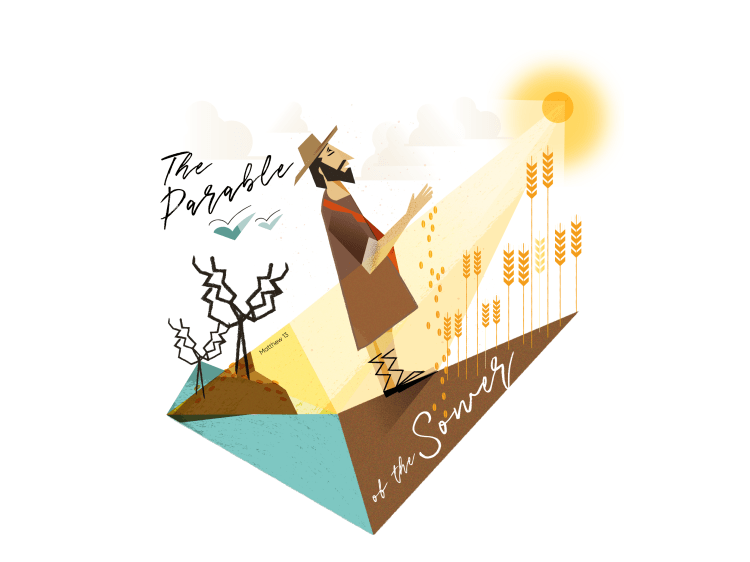
The parable of the sower and the seed must be one of the most well-known of all Jesus’ parables. It’s so well-known in fact that part of it, at least, has passed into everyday speech through that very well-known saying, ‘Some fell on stony ground’. Actually, in the context in which it’s normally meant in everyday language, that saying is incorrect because it’s normally taken to imply that what’s been heard has been ignored or disregarded, and that corresponds more with the word in the parable that is sown on the path, than with the word that’s sown on stony ground. Nevertheless, that any of the parable has become part of everyday speech is an indication of just how well-known this parable is.
Having said that people misuse this parable in everyday speech though, I think that even those who know this parable well from their reading of the Scriptures can still miss out on part of it’s meaning for us. That’s because when we read this parable, our attention is drawn towards where the seed is sown, and what happens to it after it’s been sown. In other words, our attention is drawn towards the people who hear the word, the Gospel, and what they do after hearing it.
As we know, Jesus gives us four examples to consider. There is the seed that’s sown on the path which is eaten by birds. This relates to those who hear the Gospel but don’t really listen; these are the people who, for various reasons, don’t take any notice of the Gospel. Then there is the seed which is sown on stony, or rocky, ground; the seed that sprouts quickly but withers just as quickly because it has no depth of soil in which to take root; this relates to those who hear the Gospel and seem to really take its message to heart but whom, as soon as any kind of difficulty comes along that makes actually living the Gospel hard, lapse back into their former ways. Then there is the seed that falls amongst thorns and is choked by them; this relates to those who hear the Gospel but who care too much for worldly things for the Gospel to make any difference in their lives. And finally, there is the seed that falls on good soil and produces fruit; this relates to those who hear the Gospel and take it to heart, and who become committed disciples of Christ.
I’m sure that, when we read this parable, we’re often reminded of people we’ve met, and people we know, who fall into all these various categories. And we must know people like this because, whilst Jesus presents them in the parable as distinct groups or types of people, the truth is that we’re all a mixture of these four types; each and every one of us have, to varying degrees, the characteristics of the types of people Jesus describes in the parable. So, if we think about ourselves honestly and objectively, as Christians should, this parable will have related to us, at various times in our lives, and probably still does relate to us, at times in our lives today. And I think it’s when we do think about how this parable relates to us, that we can miss out on a very important aspect of this parable.
We know this parable as the parable of the Sower and the Seeds but, I think we tend to concentrate so much on the seeds and what happens to them after they’ve been sown, that we forget all about the one who sows the seeds, we don’t pay enough attention to the sower. But the sower is a very important character in the parable and, again, one we can, and should, relate to in our own lives and in our Christian discipleship.
Although we may well possess characteristics of all four types of people Jesus describes in the parable, as Christians, our predominant characteristic should be that of the fourth group, those who have heard the word, have taken it to heart, and who are producing fruit. And if that’s not our predominant characteristic now, it should, at least, be the one we’re aiming to make our predominant characteristic in the future. But we know that, before his Ascension, Jesus asked his disciples to take the Gospel to all people and so one of the most important things we can do as Christians, one of the very best ways of producing the kind of fruit Jesus is speaking about in this parable, is to spread the word, to proclaim the Gospel or, to use the same terminology that Jesus used in this parable, to sow the seed. And that means that, as well as being amongst those Jesus speaks of as hearers of the word, we’re also proclaimers of the word; we’re called to be the sowers of the seed. So, we need to look at ourselves in relation to the sower in the parable too.
I don’t think there can be any doubt though, that some of the things that prevent us from being as good a hearer of the word as we should be, also prevent us from being as good a sower of the word as we could be. It’s quite obvious that we’re going to be hindered in sowing the seed of word if we don’t have at least some good soil within us. And so, we have to overcome the pathways and rocky ground and thorns within ourselves, because if we try to sow the seed of the word while we’re full of those things, we’ll simply be accused of hypocrisy. And perhaps one of the biggest obstacles we have to overcome as sowers of the word, is the world itself, the compromises we sometimes feel we have to make between what the Gospel teaches us to do, and what the world wants and expects us to do. And we have to overcome our fear of the world and our fear of ridicule and rejection by the world.
We know that, in the society we live in, we can come in for a great deal of criticism for being Christians, and whether that’s being made fun of for our faith or going to church, or being accused of hypocrisy, that’s not very nice to have to put up with. It can also be very difficult to have to endure the tedious lectures and tirades of the ‘You don’t have to go to church to be a Christian’ brigade, and of those who never tire of expounding the superiority of science over faith but who know little, if anything, about the Christian faith, and usually little more, if any more at all, about the science they put so much store in. But, in addition to the ridicule we get from such people, we also suffer rejection by them because they’re not likely to be good hearers of the word we sow. And this ‘double-whammy’ of ridicule and rejection can make it very difficult for us to carry on sowing the seed: it’s one thing to put up with opposition and ridicule if we think we might get somewhere in the end; it’s quite another to put up with those things in full knowledge that our efforts are very unlikely to bear fruit. But this is why we need to look closely at the character of the sower in this parable.
When we read this parable, we find that the sower is quite indiscriminate in sowing the seed, he doesn’t pick and choose where to sow the seed, rather, he scatters seeds on the path, on rocky ground, and among thorns, as well as in good soil. We also notice that, once the sower has scattered the seeds, he disappears from the story, his work is done. And as it is with the sower in the parable, so it should be for us in our lives as disciples of Christ. We should simply sow the seed, spread the word, regardless of how we think the word will be received by those we speak it to. And, once we have sowed the seed, our work, in one sense, is done. How the people we’ve spoken to respond to hearing the word is their business, ours is to sow the seed and then move on to sow more seed in other places. Of course, if the seed we sow happens to fall in to good soil, we may very well be called to nurture it and help it to grow to fruition, but that’s not our initial purpose in sowing the seed of the word. And, just as sowing seeds is a physical rather than verbal action, so we can sow the seed through our actions too. We can sow the seed through our acts of Christian charity in the world, just as much as through our words to those we meet, and perhaps more so in many ways because our words will be all the more powerful, and they’re usually taken more seriously, if they’re supported by actions.
So, as we think about this parable, by all means let’s look at ourselves as the hearers of the word and do all we can to make sure that we’re full of good soil so that the Gospel will bear fruit in us. But let’s also look at ourselves as sowers of the word and follow the example of the sower in the parable by sowing the seed of the word wherever we are and to whomever we meet. And let’s try not be put off by the pathways, the rocky ground and thorns we often sow the seed in; that is not our fault and, just as the sower in the parable wasn’t held responsible for the poor growth of some of the seed he sowed, as long as we are full of good soil ourselves so that our efforts are not hindered by accusations of hypocrisy, neither will we be held responsible for any lack of growth from the seed we sow. That is the responsibility of the hearer. Our responsibility is simply to sow the seed.
Amen.
You will find the Propers for the 15th Sunday of Ordinary Time (Trinity 5) here.
 Parish Church of St Mark Chadderton