Over the last couple of weeks, we’ve all have had to get used to the disruption that’s been caused and limits that have been placed on our lives due to the coronavirus lockdown. None of us, I’m sure, are particularly happy about the situation we now find ourselves in but, as I’ve spoken to people during this time, one thing that virtually everyone has said to me, is that they hope something will good will come from it. So many people have said to me that they hope that the care and concern for each other that people are showing now, will carry on when life returns to normal, and that when the present situation is over, a more caring society will have emerged from it. I think we would all say ’Amen’ to that.
Care and concern for one another, of course, lie at the very heart of the Gospel. Although it’s not the passage we read on Maundy Thursday, the Gospel according to St John tells us that it was on this night that Jesus gave his disciples the new commandment to love one another as he had loved them. And the things we remember and celebrate in our Maundy Thursday liturgies, are two very good examples of just how much Jesus loved his disciples.
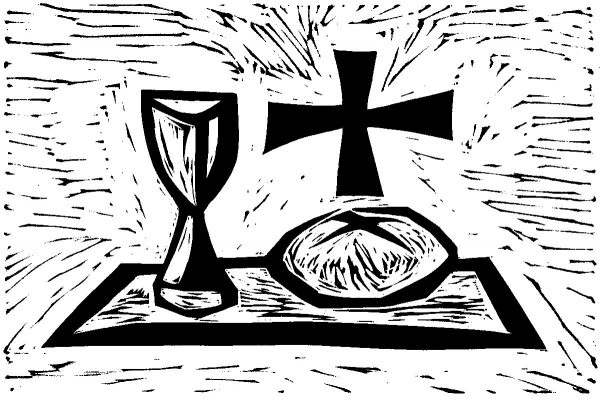
Maundy Thursday, of course, is the day when Jesus shared his last supper with his disciples, so the main thing we celebrate on the night is the institution of Holy Communion. But we also remember that before supper, Jesus washed the feet of his disciples.
In Jesus’ day, when people walked long distances on dusty roads, it was customary for the host of a meal to provide water for their guest’s feet to be washed when they arrived for the meal. The actual washing though, was a task reserved for non-Jewish slaves. So, for Jesus to wash his disciple’s feet was an act of incredible humility and servanthood, made all the more remarkable because, as Jesus said a short time afterwards, he was their Lord and Master. But in doing this, Jesus not only left an example of humility and service for his disciples to follow, he also left an example of unconditional love. Jesus washed the disciple’s feet before supper which means he also washed Judas’ feet, even though he knew Judas was about to betray him to his death. So, Jesus example, the example we, as his disciples, are called to follow, is of humility towards and loving service of all people, whoever they are, whatever they may have done, no matter how undeserving we think they are. That is what it means to love one another as he loved us.
When Jesus gave his disciples that new commandment, he said that the greatest possible act of love is to lay down one’s life for one’s friends, and of course that is exactly what Jesus did for us on the cross. And he left us a perpetual memory of that great act of love, in the Eucharist.
The earliest record we have of the words spoken by Jesus at the Last Supper are those we read in the Epistle for Maundy Thursday, 1 Corinthians 11:23-26. The words recorded by St Paul here make it very clear that Jesus intended his disciples to share in this meal in the future, to eat and drink in remembrance of him and of his great, sacrificial act of love and service on the cross, the breaking of his body and the pouring out of his blood for the forgiveness of our sins. St Paul says that every time we do this, we proclaim the Lord’s death, and that this is something Christians will continue to do until the Lord returns.
So the Eucharist is more than simply a memorial of the last meal Jesus shared with his disciples. But it’s also more than a memorial of Jesus’ Passion and death. The Eucharist is a perpetual reminder of the new covenant that Jesus’ death initiated between God and human beings. We read in the Old Testament about covenants between God and Israel being sealed by the death of an animal and the sprinkling of it’s blood, and Jesus’ words confirm that the bread and wine of the Eucharist, which in some mystical way are his body and blood, are the signs that seal the new covenant.
Not only that, in Jesus’ own Aramaic language, the word we translate as ‘body’ is the equivalent of ‘I’ or ‘me’, and in the Scriptures, blood is explicitly equated with life. When Jesus spoke of the bread as his body and the wine as his blood then, he was saying, in effect, that the bread and wine were him and his life. So, when we take and eat and drink the bread and wine of the Eucharist we are, in some way we can’t really understand admittedly, partaking and sharing in Jesus’ life, and his life is entering into us. And indeed, this is what we read in St John’s Gospel, in Jesus’ own words, “Those who eat my flesh and drink my blood abide in me and I in them.”
So the Eucharist is a another sign of Jesus great love for us. It’s a reminder of the sacrifice he made for us, a reminder of the new relationship with God his sacrifice has made possible, and it’s a way through which we can be with him and he with us. And of course, in our present circumstances, just how important being with those we love, and who love us, has been brought into very sharp focus.
This Maundy Thursday will be a strange one because we can’t be in Church to remember and celebrate Jesus’ great example of humility and service in the washing of feet. We won’t be able to eat his flesh, nor drink his blood in the sacrament of Holy Communion. But we can still remember all he has done for us, and proclaim his great, sacrificial act of love on the cross through the Act of Spiritual Communion which I know many of you have found helpful in these difficult times. We can ask Jesus to enter into us and unite us with him, spiritually. And we can look forward to and pray for the day when we can once again share in his life, and with one another, in his body and blood in the sacrament of Holy Communion.
You’ll find the Propers for Maundy Thursday here.
 Parish Church of St Mark Chadderton